
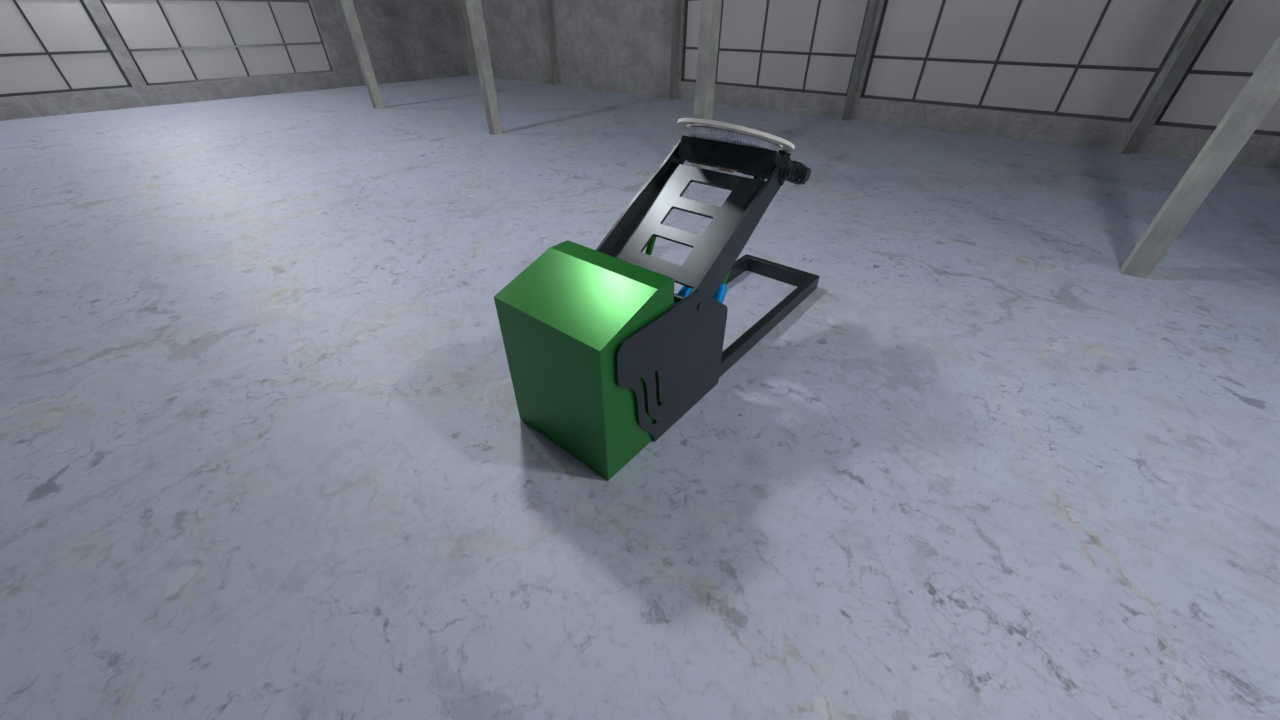
Kinematic analysis studies the motion of a mechanism’s parts (position, velocity and acceleration) without looking at the forces that cause it. In machine design it is how you see, before anything is built, whether a mechanism makes the required movement, whether parts collide and whether the stroke is long enough. This guide explains what kinematic analysis is, how it is done, and the methods and software used.
Kinematic vs kinetic (dynamic) analysis
Kinematic analysis studies the geometry of motion: which link goes where, how fast and with what acceleration? Kinetic or dynamic analysis also takes the forces and moments that produce the motion into account; for example, finding how much force a cylinder must produce requires kinetic analysis. In design the kinematics are usually verified first and the forces calculated afterwards.
Degrees of freedom: how many drives does a mechanism need?
The degrees of freedom of a planar mechanism are found with the Grübler–Kutzbach equation:
M = 3 · (n − 1) − 2 · j1 − j2
Here n is the number of links including the fixed frame, j1 the number of full joints (revolute or sliding) and j2 the number of half joints (cam or gear contact). For a four-bar linkage, n = 4 and j1 = 4, so M = 3 × 3 − 2 × 4 = 1: the mechanism is driven by a single input.
How is kinematic analysis done?
- Position analysis: For each position of the driven link, the positions of the other links are found.
- Velocity analysis: Linear and angular velocities are found by differentiating the position expressions with respect to time.
- Acceleration analysis: Accelerations are found by differentiating the velocities; they are later used for force calculations.
- Checks: Collisions, dead centres, locking and stroke limits are checked throughout the motion.
Kinematic analysis methods
- Graphical method: Velocity and acceleration polygons or instant centres are found on a drawing; quick for simple planar mechanisms.
- Analytical method: The mechanism’s loop-closure (vector loop) equations are written and position, velocity and acceleration are solved from them.
- Numerical, computer-aided method: The whole mechanism is solved on the 3D model with multibody simulation; the most practical route for complex and spatial mechanisms.
Examples of kinematic analysis
- Slider-crank mechanism: Converts rotation into linear motion; used in piston engines, pumps and presses.
- Four-bar linkage: The basis of wiper and rocking mechanisms.
- Cam and follower: Produces a given motion profile repeatedly.
- Cylinder-driven tilting mechanisms: Turn a platform or body to a given angle; the cylinder stroke and pivot points must be set with kinematics.
Kinematic analysis software
Computer-aided kinematic analysis uses the motion modules of CAD programs (such as SOLIDWORKS Motion, Autodesk Inventor Dynamic Simulation and CATIA DMU Kinematics), multibody dynamics software such as MSC Adams, and tools such as MATLAB Simscape Multibody. In SOLIDWORKS you open a Motion Study, add a motor to the assembly’s mates and run the simulation to plot position, velocity and acceleration.
When should it be done?
Kinematic analysis should be done as early in the design as possible. A simple check at concept stage is far cheaper than a collision or a short stroke discovered on the prototype. The verified motion also forms the basis of an animation that shows how the machine works.
To have your mechanism’s kinematic analysis and working-principle animation done together, see our kinematic analysis and animation service.
Frequently asked questions
What is kinematic analysis?
An analysis of the position, velocity and acceleration of a mechanism’s parts, without considering the forces that cause the motion.
How is kinematic analysis done?
First the position analysis, then velocities by differentiating positions with respect to time, and accelerations by differentiating velocities. Collisions, dead centres and stroke limits are checked throughout the motion.
Which software is used for kinematic analysis?
Motion modules of CAD programs (SOLIDWORKS Motion, Inventor Dynamic Simulation, CATIA DMU Kinematics), MSC Adams and tools such as MATLAB Simscape Multibody.
What is the difference between kinematics and kinetics?
Kinematics studies the geometry of motion; kinetic (dynamic) analysis also takes the forces and moments producing the motion into account.
Related pages
Let us analyse your mechanism
Send us your 3D model or the mechanism’s dimensions and we will prepare its kinematic analysis and working-principle animation. WhatsApp: +90 547 909 99 90 · info@dokuti.com