
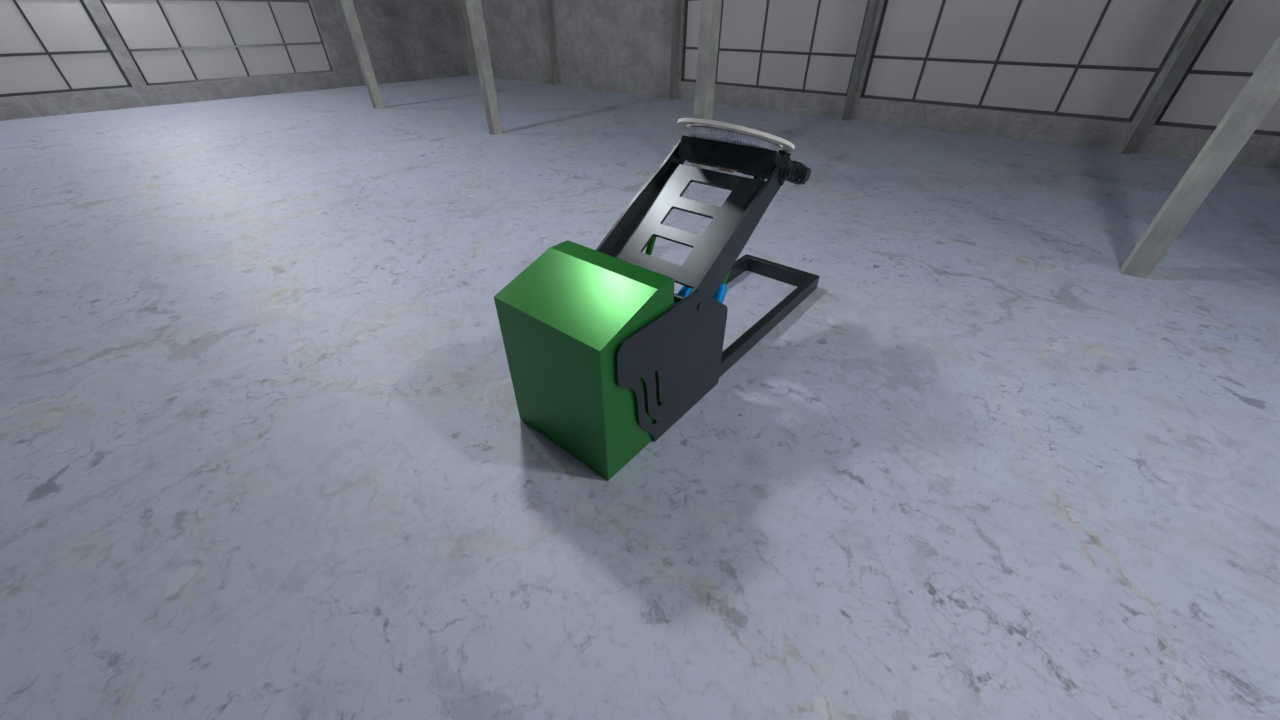
Machine design is deciding the parts, mechanisms, materials and dimensions of a machine that will do a job safely, efficiently and economically. A good design means not just a machine that works, but one that can be manufactured, maintained and run safely for years. This guide explains the principles of machine design, its stages and what to watch out for.
Principles of machine design
- Function: The machine must do the defined job at the required capacity and accuracy.
- Safety: Hazards are first removed by design; the remaining ones are reduced with guards and warnings.
- Strength and stiffness: Parts must not break, deform permanently or deflect enough to impair their function under load.
- Life and fatigue: Parts under repeated loads are sized against fatigue; bearing and wear-part lives are calculated.
- Manufacturability and ease of assembly: Parts should be producible on available machines with sensible tolerances and be easy to assemble.
- Standardisation: Standard components are used for bolts, bearings, keys and cylinders.
- Maintainability and ergonomics: Access to wearing parts and safe, comfortable operation are considered in the design.
- Cost: Material, labour, assembly and operating costs are assessed together.
The machine design process step by step
- Requirements and specification: The machine’s task, capacity, cycle time, size limits, energy sources and safety requirements are written down.
- Conceptual design: The machine’s functions are identified, and different solutions for each function are generated and compared.
- Preliminary design and sizing: The main dimensions, drive power and critical components of the chosen concept are set by calculation.
- Detail design: The machine is modelled part by part in 3D; materials, tolerances and surface finishes are specified.
- Verification: Load-bearing parts are checked with strength analysis and moving systems with kinematic analysis; a prototype is tested where needed.
- Technical documentation: Technical drawings, the bill of materials and assembly information are prepared.
- Manufacturing and commissioning: Questions during manufacturing are resolved, the machine is commissioned and its control software is adapted to it.
Machine elements and basic calculations
A machine’s safety depends largely on choosing the right machine elements: shafts, bearings, gears, belts and chains, bolted and welded joints, springs and couplings. Each element is checked for strength and life under its loads, and for vibration where needed.
Strength checks are based on the factor of safety:
S = σyield / σmax
Here σyield is the material’s yield strength and σmax the highest calculated stress in the part. The factor of safety is chosen according to the uncertainty in the loads, the material and the calculation method. Under repeated loads, fatigue strength is used instead of yield strength.
Software used in machine design
CAD programs such as SOLIDWORKS, Autodesk Inventor, CATIA, Siemens NX and PTC Creo are used for 3D modelling and drawings; finite element programs such as SOLIDWORKS Simulation and ANSYS for strength analysis; and the motion modules of CAD programs for motion analysis. Repetitive design work can be automated through the CAD programs’ programming interfaces.
Standards and regulations
- Machinery Directive (2006/42/EC): Sets the essential health and safety requirements for machines placed on the market in the EU and Türkiye; the basis of CE marking.
- EN ISO 12100: Defines general principles for safe machine design, risk assessment and risk reduction.
- ISO 2768: Gives general tolerances for dimensions not individually toleranced on drawings.
The role of design in custom machine building
In custom machine building the most expensive mistakes are the ones not seen at the design stage: a collision found after manufacturing, an undersized shaft or a part that cannot be assembled. Verifying the design with analysis and simulation before manufacturing speeds up the manufacturer’s work and reduces cost.
Choosing a machine design and engineering firm
- Do they have experience with similar machines?
- Can they verify the design with strength and motion analysis?
- Do they deliver production-ready drawings and a bill of materials?
- Can they also develop the machine’s control software, or do you need another company?
- Do they support manufacturing and commissioning?
DKT Design and Software works as a machine design and engineering firm in Ostim, Ankara: we provide machine design, structural analysis, kinematic analysis and animation and machine software, separately or together in one project.
Frequently asked questions
What is machine design?
Deciding the parts, mechanisms, materials and dimensions of a machine that will do a job safely, efficiently and economically.
How is a machine designed?
It starts with requirements and a specification, then moves through conceptual design, preliminary design and sizing, detail design, verification by analysis, technical documentation and manufacturing.
Which software is used in machine design?
SOLIDWORKS, Inventor, CATIA, Siemens NX and PTC Creo for 3D modelling, and programs such as SOLIDWORKS Simulation and ANSYS for strength analysis.
What does a machine design firm do?
It defines the machine’s requirements, designs it, verifies it with analysis and prepares the drawings and bill of materials for manufacturing. Some firms also develop the machine’s software.
Related pages
- Machine design service
- Engineering services
- Structural analysis and load calculations
- What is kinematic analysis?
Let us design your machine together
Send us what the machine must do and any sketches or photos, and we will work out the scope and schedule together. WhatsApp: +90 547 909 99 90 · info@dokuti.com